


• Home
  • Team
  • World
  • Cultivated meats
Friday, December 5, 2025
No Result
View All Result
  • Login
Cultivated Food Article and News
  • Cultivated foodTrend
    • All
    • Alternative Meat
    • Alternative Protein
    • Article
    • Cultivated meats
    • Lab-grown meat
    • Plant-based food
    • Seafood
    • Short News

    Chicken Road 2: Il suono che guida la guida silenziosa

    A rapid expansion of the cultured meat market is meeting consumer demand

    Lab-grown meat is in high demand in the APAC region

    The Alternative Protein Revolution: Is India Ready?

    The Alternative Protein Revolution: Is India Ready?

    The Future of Food by 2025

    The Future of Food by 2025

    Cultivated meat is scaled up-and its price is dramatically reduced

    A new partnership with Cult Food Science is bringing innovative meat products to market

    Public Consultation Seeks Feedback on Potential Approval of Cultivated Meat in Australia

    Public Consultation Seeks Feedback on Potential Approval of Cultivated Meat in Australia

    Indians get a taste of cultivated meat at Biokraft Foods

    Indians get a taste of cultivated meat at Biokraft Foods

    A rapid expansion of the cultured meat market is meeting consumer demand

    A rapid expansion of the cultured meat market is meeting consumer demand

    Achieving multibillion-dollar growth for lab-grown meat with Sallea

    Lab-grown meat investments by Asian countries could revolutionize the industry

    • Alternative Meat
    • Alternative Protein
    • Article
    • Cultivated meats
    • Lab-grown meat
    • Plant-based food
    • Seafood
  • World
    AdobeStock_2854144561

    “We’re reimagining meat to spare land and resources, but never flavour” Nicolas Morin-Forest said.

    head-74

    Plant-Based Meats Market Is Booming Worldwide | Gold&Green Foods, Maple Leaf Foods, Amy’s Kitchen, Garden Protein International, Quorn Foods and more

    brown-and-white-cow-on-green-grass-field-during-daytime

    The meat paradox: how your brain wrestles with the ethics of eating animals

    Are chicken feathers a greener alternative to polyester and nylon?

    Are chicken feathers a greener alternative to polyester and nylon?

    The Best Veggie Burgers Are Made With Vegetables

    The Best Veggie Burgers Are Made With Vegetables

  • Science
  • Regulations
  • Opinion
  • Short News
  • Business
  • Cultivated Seafood
  • EVENT
  • Technology
  • Cultivated foodTrend
    • All
    • Alternative Meat
    • Alternative Protein
    • Article
    • Cultivated meats
    • Lab-grown meat
    • Plant-based food
    • Seafood
    • Short News

    Chicken Road 2: Il suono che guida la guida silenziosa

    A rapid expansion of the cultured meat market is meeting consumer demand

    Lab-grown meat is in high demand in the APAC region

    The Alternative Protein Revolution: Is India Ready?

    The Alternative Protein Revolution: Is India Ready?

    The Future of Food by 2025

    The Future of Food by 2025

    Cultivated meat is scaled up-and its price is dramatically reduced

    A new partnership with Cult Food Science is bringing innovative meat products to market

    Public Consultation Seeks Feedback on Potential Approval of Cultivated Meat in Australia

    Public Consultation Seeks Feedback on Potential Approval of Cultivated Meat in Australia

    Indians get a taste of cultivated meat at Biokraft Foods

    Indians get a taste of cultivated meat at Biokraft Foods

    A rapid expansion of the cultured meat market is meeting consumer demand

    A rapid expansion of the cultured meat market is meeting consumer demand

    Achieving multibillion-dollar growth for lab-grown meat with Sallea

    Lab-grown meat investments by Asian countries could revolutionize the industry

    • Alternative Meat
    • Alternative Protein
    • Article
    • Cultivated meats
    • Lab-grown meat
    • Plant-based food
    • Seafood
  • World
    AdobeStock_2854144561

    “We’re reimagining meat to spare land and resources, but never flavour” Nicolas Morin-Forest said.

    head-74

    Plant-Based Meats Market Is Booming Worldwide | Gold&Green Foods, Maple Leaf Foods, Amy’s Kitchen, Garden Protein International, Quorn Foods and more

    brown-and-white-cow-on-green-grass-field-during-daytime

    The meat paradox: how your brain wrestles with the ethics of eating animals

    Are chicken feathers a greener alternative to polyester and nylon?

    Are chicken feathers a greener alternative to polyester and nylon?

    The Best Veggie Burgers Are Made With Vegetables

    The Best Veggie Burgers Are Made With Vegetables

  • Science
  • Regulations
  • Opinion
  • Short News
  • Business
  • Cultivated Seafood
  • EVENT
  • Technology
No Result
View All Result
Cultivated Food Article and News
No Result
View All Result
Home Cultivated food

Climate change will make the Corn Belt unsuitable for cultivating corn by 2100 without major technological advances in agricultural practices

by Admin
May 26, 2022
in Cultivated food
Reading Time: 4 mins read
0 0
0
0
SHARES
211
VIEWS
Share on FacebookShare on Twitter

Climate change will make the U.S. Corn Belt unsuitable for cultivating corn by 2100 without major technological advances in agricultural practices, an Emory University study finds. 

Environmental Research Letters published the research, which adds to the evidence that significant agricultural adaptation will be necessary and inevitable in the Central and Eastern United States. It is critical that this adaptation includes diversification beyond the major commodity crops that now make up the bulk of U.S. agriculture, says Emily Burchfield, author of the study and assistant professor in Emory’s Department of Environmental Sciences. 

“Climate change is happening, and it will continue to shift U.S. cultivation geographies strongly north,” Burchfield says. “It’s not enough to simply depend on technological innovations to save the day. Now is the time to envision big shifts in what and how we grow our food to create more sustainable and resilient forms of agriculture.”

Burchfield’s research combines spatial-temporal social and environmental data to understand the future of food security in the United States, including the consequences of a changing climate. 

More than two-thirds of the land on the U.S. mainland is currently devoted to growing food, fuel, or fiber. And about 80 percent of these agricultural lands are cultivated with just five commodity crops: Corn, soy, wheat, hay, and alfalfa. Previous research based on biophysical data has established that climate change will adversely affect the yields of these crops. 
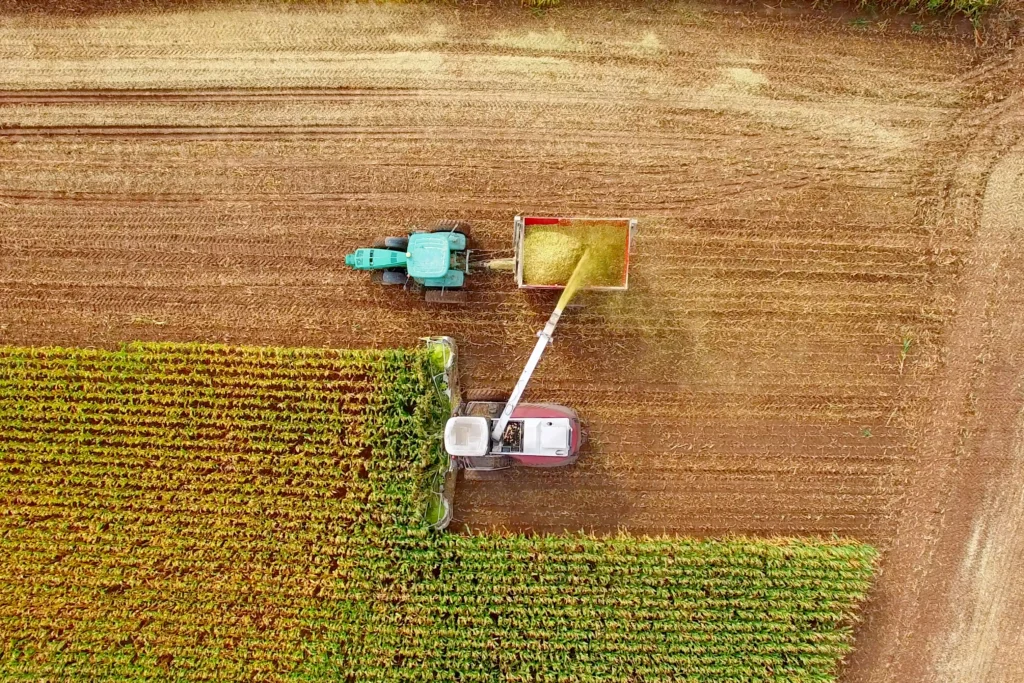
Corn

Building predictive models

For the current paper, Burchfield wanted to investigate the potential impacts of climate change on cultivation geographies. She focused on the six major U.S. crops that cover 80 percent of cultivated land in the United States: Alfalfa, corn, cotton, hay, soy, and wheat. She drew from historical land-use data classifying where these crops are grown and publicly available data from the U.S. Department of Agriculture, the U.S. Geographical Survey, the WorldClim Project, the Harmonized World Soil Database and other public sources. 

Using these data, she built models to predict where each crop has been grown during the 20 years spanning 2008 to 2019. She first ran models using only climate and soil data. These models accurately predicted — by between 85 and 95 percent — of where these major crops are currently cultivated. 

Burchfield ran a second set of models that incorporated indicators of human interventions — such as input use and crop insurance — that alter biophysical conditions to support cultivation. These models performed even better and highlighted the ways in which agricultural interventions expand and amplify the cultivation geographies supported only by climate and soil. 

Burchfield then used these historical models to project biophysically driven shifts in cultivation to 2100 under low-, moderate- and high-emission scenarios. The results suggest that even under moderate-emission scenarios, the cultivation geographies of corn, soy, alfalfa, and wheat will all shift strongly north, with the Corn Belt of the upper Midwest becoming unsuitable for the cultivation of corn by 2100. More severe emissions scenarios exacerbate these changes. 

“These projections may be pessimistic because they don’t account for all of the ways that technology may help farmers adapt and rise to the challenge,” Burchfield concedes. She notes that heavy investment is already going into studying the genetic modification of corn and soy plants to help them adapt to climate change. 

“But relying on technology alone is a really risky way to approach the problem,” Burchfield adds. “If we continue to push against biophysical realities, we will eventually reach ecological collapse.” 

Climate change will make the Corn Belt unsuitable for cultivating corn by 2100 without major technological advances in agricultural practices corn field g91bd60809 1280

The need for diverse landscapes

She stresses the need for U.S. agricultural systems to diversify beyond the major commodity crops, most of which are processed into animal feed. 

“One of the basic laws of ecology is that more diverse ecosystems are more resilient,” Burchfield says. “A landscape covered with a single plant is a fragile, brittle landscape. And there is also growing evidence that more diverse agricultural landscapes are more productive.” 

U.S. agricultural systems incentivize “monoculture farming” of a handful of commodity crops, largely through crop insurance and government subsidies. These systems take an enormous toll on the environment, Burchfield says, while also supporting a meat-heavy U.S. diet that is not conducive to human health. 

Climate change will make the Corn Belt unsuitable for cultivating corn by 2100 without major technological advances in agricultural practices Corn photo cred Adobestock E 1

“We need to switch from incentivizing intensive cultivation of five or six crops to supporting farmers’ ability to experiment and adapt the crops that work best in their particular landscape,” she says. “It’s important to begin thinking about how to transition out of our current damaging monoculture paradigm toward systems that are environmentally sustainable, economically viable for farmers, and climate-smart.” 

Burchfield plans to expand the modeling in the current paper by integrating interviews with agricultural policy experts, agricultural extension agents, and farmers. “I’d especially like to better understand what a diverse range of farmers in different parts of the country envision for their operations over the long term, and any obstacles that they feel are preventing them from getting there,” she says.

Tags: Alternative Proteinclimate changeCultivated Food
Previous Post

No longer ‘Impossible’: Silicon Valley companies envision a meat-free future

Next Post

US firm to build biggest ever vats for ‘no cruelty’ meat

Admin

Admin

Related Posts

VegNews.IHOP

IHOP JUST LAUNCHED ITS FIRST VEGAN BREAKFAST SANDWICH.

April 21, 2022
0

Vegan Restaurant chain International House of Pancakes (IHOP) just launched its first vegan breakfast sandwich at one Flip’d by IHOP location in the Flatiron neighborhood of New York City. The new Plant...

Nuggets of chicken grown in a lab and chocolate? The future of food in Yolo County

Nuggets of chicken grown in a lab and chocolate? The future of food in Yolo County

March 12, 2023
0

BY BENJY EGEL Melted chocolate whirred around a melanger in California Cultured’s workshop, destined to be poured, hardened and broken into little squares. A tasty dessert, not yet legal to sell in...

Cultivated beef companies tout sustainability. Will it lead to marketability?

Cultivated beef companies tout sustainability. Will it lead to marketability?

December 16, 2022
0

The market for lab-grown meat also called cultivated or cell-cultured meat is expected to reach $1.99 billion by 2035, growing at an annual rate of 21.4%. Beef is poised to be the dominant segment. The...

Cultivated Meat Gains Ground in Hyper-Competitive Industry

Cultivated Meat Gains Ground in Hyper-Competitive Industry

April 28, 2022
0

Investment in cultivated meat is reaching unprecedented levels, as innovative new technology has paved the way for the development and deployment of great-tasting, sustainable foods. But some experts question whether it will...

Load More
Next Post
US firm to build biggest ever vats for ‘no cruelty’ meat

US firm to build biggest ever vats for ‘no cruelty’ meat

Leave a Reply Cancel reply

Your email address will not be published. Required fields are marked *

About US

At CultivatedMeats, we’re passionate about the future of food, products, and events that are grown and produced in harmony with nature. We believe in a world where cultivation goes beyond just farming and enters every aspect of our lives.

Cultivated Meats all right reserved text © 2024

Welcome Back!

Login to your account below

Forgotten Password?

Retrieve your password

Please enter your username or email address to reset your password.

Log In
No Result
View All Result
  • Cultivated food
    • Alternative Meat
    • Alternative Protein
    • Article
    • Cultivated meats
    • Lab-grown meat
    • Plant-based food
    • Seafood
  • World
  • Science
  • Regulations
  • Opinion
  • Short News
  • Business
  • Cultivated Seafood
  • EVENT
  • Technology

Cultivated Meats all right reserved text © 2024