



Are they healthier and can they save the environment?
| THE INDEPENDENT | Global food systems face the challenge of providing healthy and adequate nutrition through sustainable means, which is exacerbated by climate change and increasing protein demand by the world’s growing population.
Recent advances in novel food production technologies demonstrate potential solutions for improving the sustainability of food systems. Yet, diet-level comparisons are lacking and are needed to fully understand the environmental impacts of incorporating novel foods in diets.
Results of new research published in the journal Nature Food, estimate the possible reductions in global warming potential, water use and land use by replacing animal-source foods with novel or plant-based foods in European diets.

When the researchers zeroed in on omnivore, vegan and novel food diets for minimum environmental impacts with nutrition and feasible consumption constraints, they say they found that replacing animal-source foods in current diets with novel foods reduced all environmental impacts by over 80% and still met nutrition and feasible consumption constraints.
The researchers say inclusion of novel foods such as cultivated meat and dairy would offer a more complete nutrient package than vegetarian and vegan diets. Insect protein was also considered, specifically flies and crickets, alongside plant proteins extracted from algae and mushrooms. The new study comes out of Finland’s University of Helsinki. The researchers do not suggest removing animal meat altogether, but rather focusing on different species.
The BBC reported on the research findings under the interesting headline “Lab-grown meat and insects ‘good for planet and health’.
The story listed the so-called `novel foods’ studied – some of which are still on the drawing board – as: Ground-up flies and crickets, egg white from lab-grown chicken cells, a type of seaweed called kelp, protein powders made from mushrooms or microbes, edible algae, and milk, meat and berries grown from cells in a lab.

Dining on the likes of lab-grown meat or ground-up insects could lead to big savings in carbon emissions and water, as well as freeing up land for nature, it said.
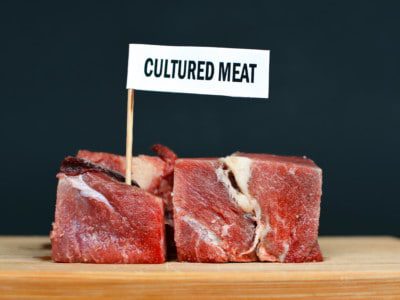
Conventional meat accounts for almost 60 percent of all greenhouse gas emissions coming from food production. It is resource heavy and increasingly ethically unpalatable. Cultivated alternatives are being developed to tackle both the moral and climate-related consequences. They are cited as an answer to the global concern of food security and increasingly, more nations are seeking to get involved. With cultivated meat, no animals will be slaughtered and no land will be sacrificed to rear the animals.
According to the Good Food Institute, cultivated meat is meat produced directly from cells. The process of cultivating meat uses the basic elements needed to build muscle and fat and enables the same biological process that happens inside an animal. Cultivated meat is identical to conventional meat at the cellular level.
Good Food Institute, an international nonprofit reimagining meat production and a world where alternative proteins are the default choice, says the idea of cultivating meat without the animal has a long history.

In 1931, Winston Churchill reportedly predicted, “We shall escape the absurdity of growing a whole chicken in order to eat the breast or wing, by growing these parts separately under a suitable medium.”
Professor Mark Post and his team at Maastricht University debuted the first cultivated burger in August 2013. In 2016, the first cultivated meat company, UPSIDE Foods, launched publicly. Mosa Meat and Super Meat soon followed. JUST Foods sold the first cultivated meat product in 2020, debuting chicken nuggets at a restaurant in Singapore.
Cultivated meat consortiums around the world are seeking to promote their products and to collect better consumer feedback. Consumer acceptance may be challenging. Insect protein could be an even harder sell.
A study published in 2019 in the journal Frontiers in Nutrition pointed out that at least 2 billion people — a quarter of the world’s population — regularly eat insects.
“The rest of us will need a bit more encouragement,” said Prof. Mauro Serafini, its lead author.
Providing selfish and immediate incentives could help consumers to make the environmentally friendly choice, says Serafini. Taste and image are key — but for many, health is also an incentive.
“Edible insects are an excellent source of protein, polyunsaturated fatty acids, minerals, vitamins and fiber. But until now, nobody had compared them with classical functional foods such as olive oil or orange juice in terms of antioxidant activity.”
The study
The researchers tested a range of commercially available edible insects and invertebrates, using various measures of antioxidant activity.
Inedible parts like wings and stings were removed, then the insects were ground and two parts extracted for each species: the fat, and whatever would dissolve in water.

Each extract was then tested for its antioxidant content and activity. Antioxidant activity is that free-radical scavenging ability that typically designates a ‘superfood’ — although this poorly defined term is eschewed by researchers, said Serafini.
“For perspective, using the same setup we tested the antioxidant capacity of fresh orange juice and olive oil — functional foods that are known to exert antioxidant effects in humans,” Serafini explained.
Water-soluble extracts of grasshoppers, silkworms and crickets displayed the highest values of antioxidant capacity — fivefold higher than fresh orange juice — while giant cicada, giant water bugs, black tarantula and black scorpions showed negligible values.
“Fat from giant cicadas and silkworms showed twice the antioxidant activity of olive oil, while black tarantula, palm worm and black ants are placed in the bottom of the ranking,” Serafini said.
Is food tech guaranteed to be the future?
According to the BBC, Dr Asaf Tzachor of the University of Cambridge, who was not part of the research team, said while these are “promising” findings, the unwillingness of consumers to shift their diets might “postpone, or indeed prevent, this much-needed transition”.

Numerous studies have shown that moving towards a plant-based diet has benefits for both health and the planet.
While novel and future foods could have significant emissions savings of novel and future foods, the researchers concede that low-tech solutions produced comparable results.
“Vegan and flexitarian or partially omnivore diets, mainly reducing meat consumption, will be important diet shifts for synergistic benefits to health and environmental outcomes,” the authors write. “However, due to less favourable profiles in terms of some nutrients in plant-based options – such as pulses and grains – diet-level comparisons with omnivore and plant-based diets are also needed to investigate the feasibility of including novel foods in future diets to meet nutritional needs with lower impacts.”
The researchers say that the lack of information surrounding the impact of diets featuring novel foods makes concrete findings impossible. Trade-offs between complete nutrition and environmental consequences are expected to be witnessed in the future when food tech solutions are widely available. The report does state that a reduction in meat intake and increase in vegetables leveraged similar projected benefits to personal and planetary health.
According to one report on the research, the findings contain a lot of speculation and conjecture. Projections about nutritional profiles and positive environmental impact cannot be proven or disproven as yet. But, the report says, that won’t stop novel food development from progressing.